
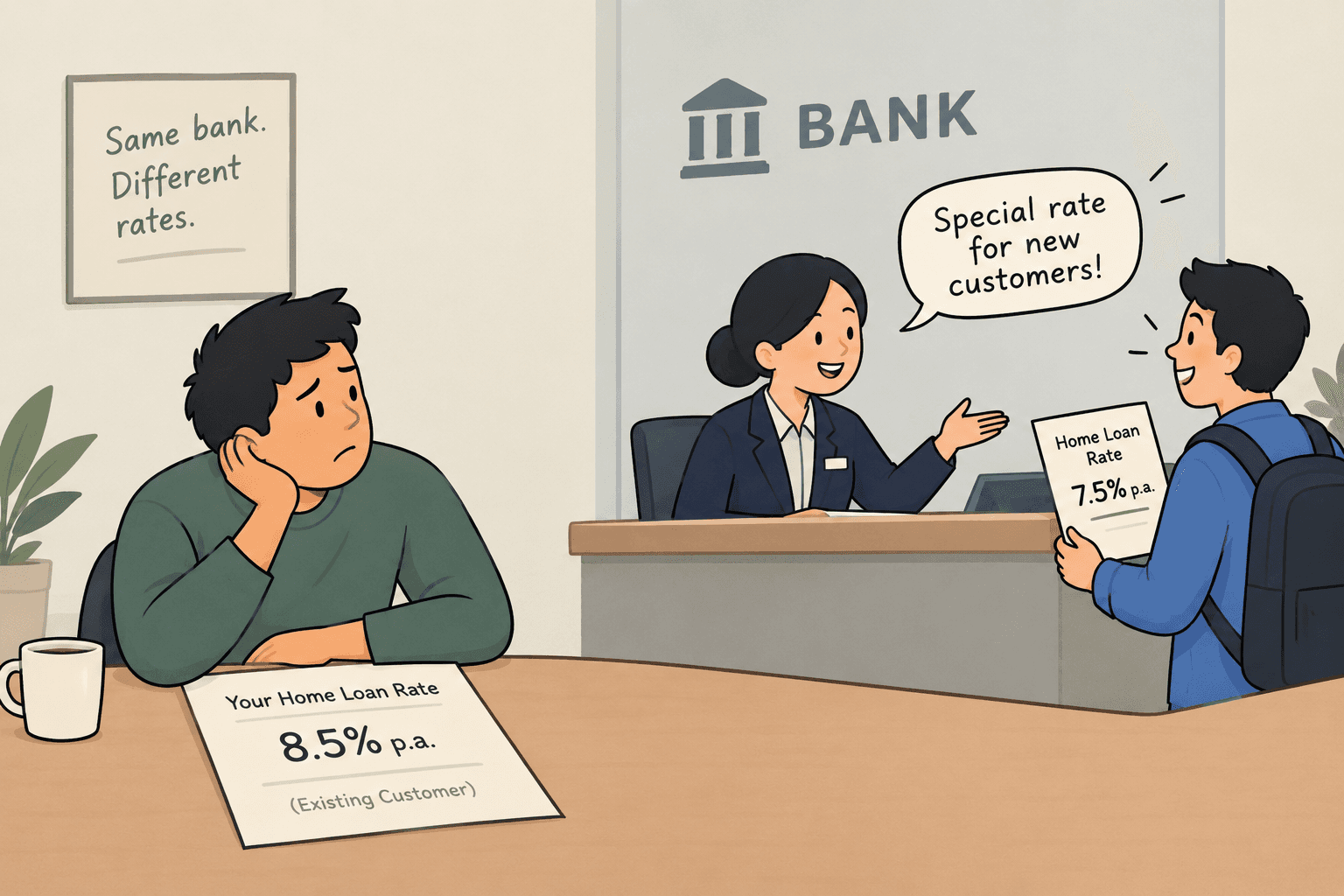
Somewhere right now, a bank is offering a lower home loan rate to a stranger than it's charging you.
Not because you did anything wrong — just because new customers are who banks compete for. Existing borrowers quietly stay on the old rate, sometimes for years, until they notice or ask. Most people don't notice. The EMI auto-debits, the number feels familiar, and the gap between what you're paying and what's actually available just sits there, compounding.
Here's what that gap actually looks like in numbers.
The math: say you took an ₹80 lakh loan at 8.5%, 20-year tenure. Your EMI is about ₹69,425. Five years in, your outstanding balance is roughly ₹70.5 lakh — you've paid a lot in interest, but the principal hasn't moved nearly as much as it feels like it should have.
In that same five years, say the RBI has cut the repo rate a couple of times, and a new lender is now offering 7.5% on a similar profile — a full 1% lower than what you're still paying. Move your remaining ₹70.5 lakh balance there, and your EMI on the remaining 15 years drops to about ₹65,357. That's roughly ₹4,068 saved every month. Over those 15 years, that's close to ₹7.3 lakh in reduced payments. Processing fees, legal and valuation charges, and stamp duty on a transfer this size typically run ₹60,000–80,000. Net saving: still around ₹6.6 lakh — for a rate cut most borrowers never even check for, let alone act on.
Nobody calls to run that math for you. It's on you, every year, for the 15–20 years the loan runs — and the moment you stop checking is the moment you start quietly overpaying.
That's the gap Sva closes. We stay with you after disbursement, check your rate against the market every year, and tell you plainly when a transfer would save money after every cost. When rates drop, we tell you right away — so you can go back to your bank and negotiate, instead of finding out over a year later.
You got approved for more than you can actually afford
Ask anyone what they focused on during their loan approval, and it's almost always one number: how much am I eligible for. Eligibility is the max a bank will lend based on income. Affordability is what you can actually repay once property tax, insurance, maintenance, and the ordinary cost of owning a home are in the picture — and banks only ever answer the first question.
The math: say your monthly income comfortably supports an EMI of ₹85,000. A bank looking purely at that number might approve you for a loan of nearly ₹98 lakh. But once you factor in the real cost of owning that home — property tax, home insurance, society maintenance, the occasional repair — that ₹85,000 of "EMI capacity" is really closer to ₹65,000–70,000 once those costs are set aside. At that EMI, the loan you can actually carry comfortably is closer to ₹75–80 lakh. Nobody flags that ₹18–20 lakh gap during approval. You find out about it the hard way, three years in, when a slow month collides with an EMI date and there's nothing left over.
There's a second number banks never walk you through either: what your loan really costs after tax benefits. Interest paid on a home loan is deductible up to ₹2 lakh a year under Section 24(b), and principal repayment counts toward the ₹1.5 lakh 80C limit. On an ₹80 lakh loan at 8.5%, your first year's interest is roughly ₹6.7 lakh — of which only ₹2 lakh is deductible, since the cap kicks in well before the full interest is covered on a loan this size. In the 30% tax bracket, that's still about ₹60,000 saved in year one, which effectively lowers your real cost of borrowing below the rate printed on your loan agreement. Most borrowers never see this number, so they never realize their effective interest rate is lower than what they signed up for.
None of this is complicated. It's just easy to miss until it's too late. That's why our calculator doesn't stop at EMI — it factors in the extra costs of owning the home, the tax benefits you're entitled to, and what your total interest outgo actually looks like once those benefits are accounted for. And alongside it, blogs and social content that walk through exactly the things people don't think to ask about — so you make the decision with the full picture, not just what the bank tells you.
Try the affordability calculator →
Why the "best" lender you're offered often isn't the best one for you
Here's something most borrowers never think to ask: who is the person recommending my lender actually working for?
A lot of intermediaries earn commission from the lender they place you with. That's not automatically dishonest, but it creates a quiet incentive — recommend whoever pays best on this deal, not whoever fits you best. You never see this happening — you just end up with a loan that suited someone else's payout, not your needs.
Let's be upfront: Sva is also an intermediary — we earn from placing loans, same as anyone else. The difference is what decides the recommendation: your income and goals, not which lender pays the best commission on this deal. We'd rather get this right for you than get paid more for getting it wrong — because a customer who trusts the recommendation comes back, and sends others our way. That compounds. A one-time payout doesn't.
The pattern underneath all three
Skip the rate check, and you can overpay by lakhs over the loan's life. Borrow the max instead of what fits, and the loan becomes a source of stress instead of security. And if your advisor's priorities end at disbursement, neither of those is theirs to fix.
Sva exists to close all three — ongoing rate tracking with real balance-transfer math, education that surfaces what usually goes unnoticed, and a model built to stay useful long after the loan closes.